Introduction
Temple Growing Animation
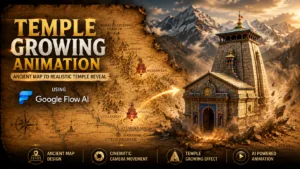
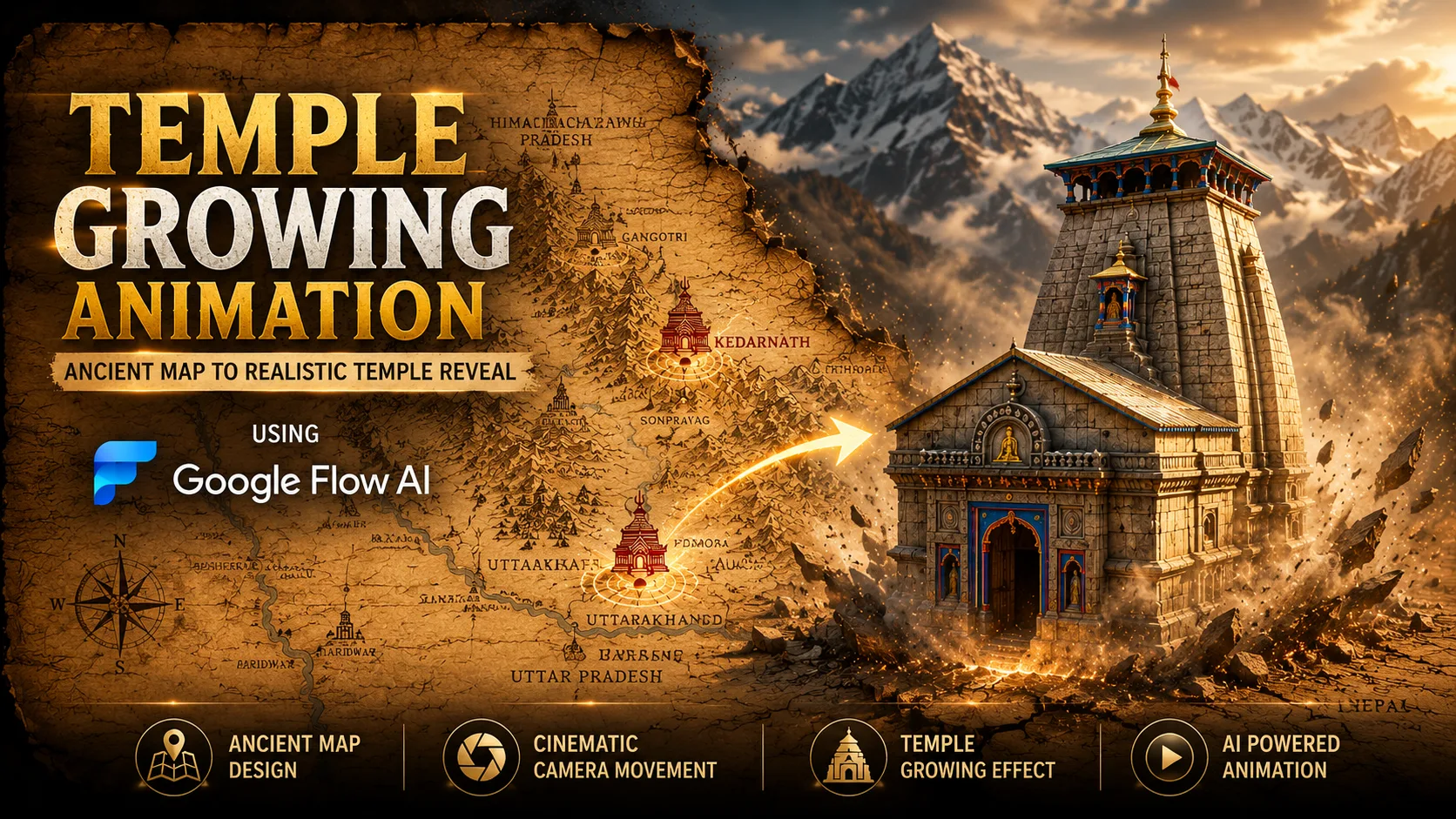
Artificial Intelligence has completely transformed digital storytelling. Today, creators can turn a simple static image into a cinematic masterpiece without spending weeks learning complex 3D software. One of the most fascinating techniques is creating an ancient map animation where a sacred temple location is highlighted before the temple gradually emerges from the map in a realistic cinematic sequence.
In this project, I created a historical animation featuring an ancient parchment map of India that transforms into a majestic temple. The entire workflow was built using Google Flow AI, combining AI-generated map artwork, realistic temple imagery, and smooth cinematic camera movement.
The result is an immersive historical visualization that feels like opening an ancient manuscript where history comes alive.
This article explains the complete creative process, from designing the vintage map to generating the final temple emergence animation.
The Creative Concept
The idea was inspired by historical exploration.
Imagine opening an ancient parchment map that shows the sacred geography of India. As the camera slowly moves across the map, a glowing red temple symbol marks a holy destination.
Instead of ending there, the camera continues to zoom into that location.
Suddenly the flat map begins transforming.
The temple rises from the ancient paper, almost as if history itself is being reconstructed before your eyes.
This effect creates a perfect blend of history, mythology, architecture, and cinematic storytelling.
Designing the Ancient Map
The first step was creating a realistic vintage map.
Instead of a modern GPS-style map, the artwork was designed as an old parchment filled with traditional cartographic elements.
The map includes:
- Hand-drawn mountain ranges
- Ancient river sketches
- Vintage ink illustrations
- Decorative compass rose
- Geographic labels
- Burnt paper edges
- Cracked parchment texture
- Dust and age marks
- Warm sepia color grading
The goal was to make the artwork feel centuries old while still accurately representing India’s geography.
For every temple project, the map focuses on the corresponding region.
Examples include:
- Tirumala Tirupati
- Thanjavur
- Thiruvannamalai
- Kedarnath
- Other sacred pilgrimage destinations
Each location is marked with a red temple icon to guide the viewer’s attention naturally.
Highlighting the Sacred Location
One important storytelling element is the sacred marker.
Rather than simply placing a pin, the animation uses a traditional red temple symbol inspired by ancient manuscripts.
This marker immediately communicates that the location is spiritually significant.
The viewer instantly knows that something important is about to happen.
This small design choice dramatically improves the visual storytelling.
Creating the Temple Image
After preparing the map, the next step was obtaining a high-quality aerial view of the temple.
Instead of using low-resolution images, the temple photographs were enhanced into ultra-high-resolution cinematic visuals.
The enhancement process focused on preserving authentic architecture while increasing clarity.
Special attention was given to:
- Stone carvings
- Temple towers (Gopurams)
- Vimana details
- Granite textures
- Courtyard layout
- Architectural symmetry
- Historic proportions
Unlike stylized AI artwork, the goal was realism.
Every architectural element needed to remain faithful to the original temple.
Cinematic Image Enhancement
The temple photographs were carefully enhanced with professional cinematic grading.
The improvements included:
Ultra High Resolution
Fine carvings became visible.
Temple walls appeared sharper.
Stone textures looked naturally weathered.
Architectural edges became cleaner without looking artificially sharpened.
Golden Hour Lighting
Lighting plays a major role in visual storytelling.
The images were enhanced using warm golden-hour sunlight featuring:
- Soft directional light
- Warm highlights
- Gentle shadows
- Increased depth
- Balanced HDR
This lighting creates a timeless spiritual atmosphere.
Film Color Grading
The final color grading used cinematic tones rather than oversaturated colors.
The overall look includes:
- Warm golden highlights
- Slight teal shadows
- Natural vegetation
- Rich stone colors
- Controlled contrast
The result feels similar to scenes from historical documentaries.
Bringing Everything Together with Google Flow AI
Once both assets were ready, the real magic happened inside Google Flow AI.
Instead of manually animating every frame, Google Flow AI generated smooth cinematic motion from static images.
The workflow is surprisingly efficient.
The animation begins with a completely flat ancient parchment map.
The camera slowly moves across the map toward the highlighted sacred location.
As the camera reaches the temple symbol, the paper begins transforming.
The temple gradually rises from the parchment.
Walls emerge.
Temple towers become visible.
Architectural details continue growing until the complete structure appears.
Finally, the camera transitions into a realistic aerial cinematic view.
This creates an incredible illusion that history is physically reconstructing itself.
Why the Temple Growing Effect Works
The temple growth animation is visually powerful because it combines two ideas:
History
and
Architecture.
Instead of simply showing a temple photograph, the viewer experiences the journey.
The animation tells a story.
First there was history.
Then the sacred location.
Finally the monument itself.
This sequence naturally builds curiosity and emotional connection.
Maintaining Historical Authenticity
One of the biggest challenges when using AI is maintaining historical accuracy.
During this project, every effort was made to preserve authentic temple architecture.
Important architectural components remained unchanged:
- Gopuram proportions
- Temple courtyards
- Entrance alignment
- Compound walls
- Sacred towers
- Stone structures
No fantasy elements were introduced.
The objective was realism rather than artistic exaggeration.
Smooth Camera Motion
Camera movement is one of the reasons the final animation feels cinematic.
Instead of quick transitions, the movement follows a documentary style.
The camera:
Slowly approaches the map.
Moves naturally toward the temple marker.
Continues zooming inward.
Transitions into the emerging temple.
Finally settles into an aerial cinematic shot.
The slow pacing allows viewers to appreciate both the historical map and the magnificent architecture.
Ideal Applications
This animation style can be used for many different projects.
Examples include:
- YouTube history channels
- Temple documentaries
- Travel films
- Religious storytelling
- Heritage preservation
- Educational videos
- Tourism promotion
- Cultural exhibitions
- Museum presentations
- Social media reels
The technique works for almost any historical landmark.
Why Google Flow AI is Perfect for This Workflow
Google Flow AI dramatically reduces the amount of manual animation work.
Instead of building complex 3D scenes, creators can generate cinematic transitions using carefully prepared source images.
Its strengths include:
- Smooth camera movement
- Natural scene transformation
- Consistent visual quality
- Fast workflow
- Cinematic motion generation
- High-quality AI interpolation
For creators who want professional-looking historical videos without expensive software, this workflow offers an excellent solution.
Future Possibilities
This animation technique can easily be expanded.
Instead of a single temple, an entire pilgrimage journey could be visualized.
Imagine an ancient map where multiple sacred locations glow one after another.
Each location could transform into:
- Tirupati Temple
- Thiruvannamalai Temple
- Kedarnath Temple
- Badrinath Temple
- Rameswaram Temple
- Meenakshi Temple
- Brihadeeswara Temple
Each destination could emerge from the map before transitioning into cinematic aerial footage.
This creates an engaging visual journey across India’s rich spiritual heritage.
Map Image prompt
Top-down orthographic view of an ancient parchment map focused on ( north India, highlighting the region of kedarnath ). The map is highly detailed with vintage cartography elements — faded ink lines, hand-drawn terrain, subtle compass markings, and geographic sketches. The paper texture is aged with visible cracks, dust, burn edges, and sepia tones. A sacred red ink marking (temple symbol) precisely indicates the location of (Kedarnath). Lighting is soft and cinematic, with gentle shadows enhancing paper texture. No 3D elements yet — purely flat map. Ultra-realistic texture, 4K, cinematic, historical aesthetic.
Image Enhance Prompt
Enhance the provided aerial image into an ultra-high-resolution cinematic masterpiece. Resolution & Detail: Upscale to true 4K or higher. Restore and enhance micro-details — intricate stone carvings, sculptural reliefs, weathered granite textures, temple inscriptions, and architectural edges must appear crisp and naturally defined (no artificial sharpening artifacts). Architecture Accuracy: Preserve authentic Dravidian temple architecture. Maintain precise geometry, proportions, and symmetry of the vimana, gopuram, courtyards, and compound walls. No distortions or structural alterations. Reconstruction & Cleanup: Remove noise, compression artifacts, and blur. Reconstruct missing fine details realistically using context-aware enhancement. Improve edge definition while keeping natural softness. Composition (1:1): Reframe into a perfect square aspect ratio. Keep the main vimana centered and dominant. Ensure balanced framing with visible entrance gopuram and surrounding walls. Lighting (Golden Hour Cinematic): Apply warm golden-hour lighting: Soft directional sunlight from a low angle Warm highlights on stone surfaces Gentle shadows enhancing depth No blown highlights or harsh contrast Depth & Atmosphere: Enhance spatial layering: Sharp foreground (temple structures) Slight atmospheric softness in background (town/trees) Subtle haze for depth realism Color Grading: Film-grade cinematic color: Rich warm tones (golden-orange hues on stone) Natural greens in surroundings Balanced contrast (not oversaturated) Slight teal-shadow / warm-highlight cinematic balance Realism Constraints: Ultra-realistic output only. No stylization, no fantasy elements, no painterly effects, no exaggeration. Final Quality: Noise-free, highly detailed, cinematic aerial photograph, professional-grade HDR finish.
Video Prompt
Create a cinematic transformation video from a flat parchment map into a realistic temple environment. Start with the provided map image in a perfectly top-down orthographic view. The red temple marker is the exact origin point. The map begins to come alive — terrain subtly rises, textures blend from parchment into real (earth), and miniature landscape elements grow outward organically. Pathways, greenery, and terrain form first, followed by architectural elements. The Brihadeeswarar Temple emerges progressively from the marker — base structure forms, walls and carvings develop, and the vimana rises last as the tallest focal point. Transition smoothly from miniature scale into full-scale realism. The camera tilts gradually from top-down into a cinematic aerial angle (35–45 degrees), maintaining perfect alignment with the original map center. End by matching the provided final image exactly in composition, lighting, and perspective. Constraints: Perfect positional continuity between map marker and temple Smooth continuous morph (no cuts) Stable camera, no jitter No distortion or warping Style: Photorealistic, cinematic, golden hour lighting, high detail, epic historical tone.
Final Thoughts
Creating an ancient map that transforms into a living temple is more than just an AI experiment—it is a new way of telling historical stories. By combining vintage cartography, authentic temple architecture, cinematic lighting, and AI-powered animation through Google Flow AI, a static image becomes an immersive visual experience that captures both the grandeur of India’s sacred heritage and the imagination of modern audiences.
This workflow demonstrates how technology can preserve and present cultural landmarks in a fresh and engaging format. Whether you’re producing YouTube documentaries, travel films, educational content, or heritage showcases, the combination of an ancient parchment map and a temple growth animation offers a unique storytelling style that feels both historical and cinematic.
As AI tools continue to evolve, creators now have the ability to transform centuries of history into visually compelling narratives with remarkable realism. The journey from an old map to a magnificent temple is not just an animation—it is a bridge between the past and the future, allowing viewers to experience history in a way that was once only possible through large-scale film production.
Temple Growing AnimationTemple Growing AnimationTemple Growing AnimationTemple Growing AnimationTemple Growing AnimationTemple Growing AnimationTemple Growing AnimationTemple Growing AnimationTemple Growing AnimationTemple Growing AnimationTemple Growing Animation